The distinction between Japanese and non-Japanese is unclear in this context. If a consumer finds a product unsatisfactory, it's natural to file a complaint. Some consumers may question the product's quality, while others may offer constructive suggestions for improvement.
Most sellers in such situations either offer an explanation, apologize, or promise to deliver a better product in the future. Some sellers even offer refunds, although this is rare, and some even offer additional features to appease the customer.
However, there are also sellers who, angered by the customer's reaction, blame them, saying that if they didn't like the product, they could shop elsewhere. Such arrogant sellers should understand that there's no need to show the customer the door, as the customer themselves won't buy from them in the future. Furthermore, such customers may also warn other potential buyers away from that store.
This is a common scenario in buying and selling, and no third person shuould be upset on it.
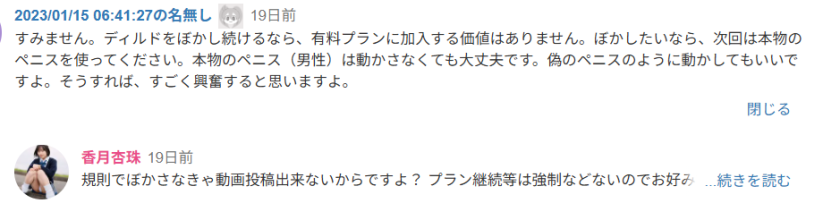
The way the message is written is VERY foreigner. There are not enough elipses in the sentences. The "(男性)" looks super strange in this context.
The structure itself of the text looks like it was written in English and then put in google translator or something equivalent.
The way of thinking is very foreigner. You just not write like that to a gravure idol.
Someone Japanese will classify Anjyu as gravure idol. So he will not use those words, that's extremely not appropriate.
Even the logical of the whole reply does not sound at all Japanese, in fact. It is written as if it was a foreign customer vs foreign buyer.
To explain better, i will use your last reply here and show how much "foreigner" it is:
->"If a consumer finds a product unsatisfactory, it's natural to file a complaint." : No, not really. The "natural way" here is to say nothing and not buy again (and that's what Anjyu answered to that person, by the way). The "not natural but that sometimes exist" is to do an indirect sentence. Here the general rule is 波風を立てない.
-> The logical "buyer vs seller" presented in your reply is also not used as much as you may think here. It is not aggressive like that. "There may be a misunderstanding" or "Expectations may differ" is the natural approach.
-> "Such arrogant sellers should understand that there's no need to show the customer the door" : that sentence sounds extremely aggressive. This approach not used like that at all here.
-> "no third person should be upset on it" : no, that's also not how it works, every third person here will be a little upset, even if they don't express it. It is like foreigner shouting in the subway. Everybody will feel a little upset, but give you a gaijin card, even if they keep silent.
To summarize : I am 99% sure it is text written by foreigner, because it ignores all the social rules used when talking about something, plus it is not "natural" japanese sentence / vocabulary / structure.
And the person who wrote the comment to Anjyu is thinking like you think in your last reply, which is really not Japanese.
I hope my previous message is more clear now.